
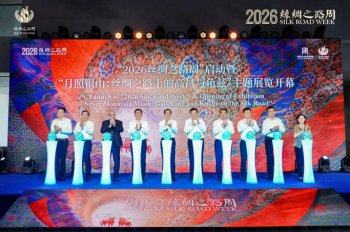
On June 24, the 2026 Silk Road Week opened at the China National Silk Museum in Hangzhou, China. Jointly organized by the National Cultural Heritage Administration and the People’s Government of Zhejiang Province, this year’s event is themed “Harmony in Diversity, For a Shared Future” and features the Xinjiang Uygur Autonomous Region as the guest province and Morocco as guest country. Mr. Rao Quan, Vice Minister of the Ministry of Culture and Tourism and Administrator of the National Cultural Heritage Administration; Abdelkader El Ansari, Moroccan Ambassador to China; Kaiser Abdukerim, Vice Chairman of the Government of the Xinjiang Uygur Autonomous Region; and Hu Wei, ice Governor of Zhejiang Province, attended the opening ceremony and delivered remarks.
At the ceremony, Chinese and international guests jointly inaugurated the 2026 Silk Road Week, the themed exhibition Silver Mountain Moon: Gaochang and Kucha on the Silk Road, and Morocco’s guest country program. The 2025 Annual Report on Silk Road Cultural Heritage was also released, highlighting the exchange, mutual learning, and rich historical legacy of Silk Road civilizations. The ceremony also witnessed the signing of an agreement between the China National Silk Museum and the Bowers Museum in the United States to establish an overseas exhibition gallery for the museum.
The main exhibition of the 2026 Silk Road Week, Silver Mountain Moon: Gaochang and Kucha on the Silk Road, is organized around cultural artifacts unearthed along the Silk Road dating from the Han to the Tang dynasties (202 BCE–907 CE). Bringing together more than 200 items and sets from 14 institutions in Xinjiang and Zhejiang, the exhibition draws on ancient city sites, grotto remains, and excavated artifacts to illustrate the central government’s effective administration of the Western Regions during the Han and Tang dynasties, as well as the flourishing economic and cultural exchange and integration along the Silk Road. It also highlights the openness, inclusiveness, and enduring vitality of Chinese civilization.
This year’s program also spotlights guest country Morocco through an exhibition of traditional Moroccan dress. Featuring more than 50 items and sets of Moroccan caftans and related accessories, the exhibition includes regional traditional caftans, traditional accessories, modern caftans, and contemporary bridal caftans, offering Chinese visitors a comprehensive look at the caftan tradition and its distinctive aesthetic.
The “Silk Road Night” event was held on the opening night alongside a curatorial presentation for the “Desert Oasis Silk Road” project of the Digital Silk Road Museum, during which a list of selected curatorial projects was announced. The evening also featured exchanges on cultural heritage and fashion.
As part of the main program, the China National Silk Museum and the Key Scientific Research Base for Textile Conservation of the National Cultural Heritage Administration will host an academic symposium focusing on cultural heritage and intangible cultural heritage along the Silk Road. The symposium will explore the themes of mutual learning among civilizations, technological empowerment, and transmission and innovation, contributing the latest research and insights from the forefront of Silk Road studies to global dialogue among civilizations.
Source: Zhejiang Cultural and Tourism Affairs