
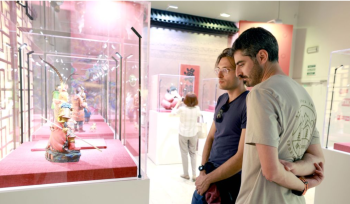
On August 18, an exhibition titled Harmony Creates Beauty: An Art Exhibition of Ancient Chinese Civilization opened at the National History Museum of the Kyrgyz Republic in the country's capital. The three-month exhibition, under the direction of China's National Cultural Heritage Administration, is jointly organized by the Tianjin Municipal Administration of Culture and Tourism, the Cultural Relics Bureau of the Inner Mongolia Autonomous Region, the Tianjin Museum, the Inner Mongolia Museum, the National History Museum of the Kyrgyz Republic, and the Chinese Cultural Center in Bishkek.
This exhibition is a project under the National Cultural Heritage Administration's 2026 "Civilization Bridge Program – Outbound Exhibitions" initiative. The exhibition features 153 exhibits from China's Tianjin Museum and Inner Mongolia Museum as well as the National History Museum of the Kyrgyz Republic. It features 153 sets of precious exhibits carefully selected from the collections of the Tianjin Museum, the Inner Mongolia Museum, and the National History Museum of the Kyrgyz Republic. Among them, 145 sets are Chinese exhibits, including important artifacts such as oracle bones of the Shang Dynasty(1600 BCE-1046 BCE), Ke Bo bell and Ke Zhong bell of the Western Zhou(1046 BCE-771 BCE), a antler-shaped gold step shake of the Wei and Jin period(220 CE-420 CE), a sheep-shaped lamp of the Han Dynasty(202 BCE-220 CE), a winged-figure grape mirror of the Tang Dynasty(618 CE- 907 CE), a high-footed gold cup of the Yuan Dynasty(1271 CE -1368 CE), a lotus-and-fish cinnabar Chengni inkstone of the Ming Dynasty(1368 CE -1644 CE), a silk tapestry scroll of Emperor Minghuang Trying His Horse of the Qing Dynasty(1644 CE-1911 CE) and a set of Kangxi-period polychrome "Twelve Months" flower-cup vessels from the Qing Dynasty. Eight Kyrgyz treasures, including the Markham Mask, openwork plaque ornaments, and bronze mirrors, are also presented alongside. This is the largest-scale, highest-quality, most diverse, and most chronologically extensive joint exhibition ever held between China and Kyrgyzstan.
Centered on the Chinese philosophy of "harmony and unity", the exhibition is divided into three sections: "The Land of Rites – Upholding Virtue and Goodness," "The Essence of China – Culture Spanning Past and Present," and "Harmonious Coexistence – Embracing All Rivers." A dedicated gallery for intangible cultural heritage (ICH) is also featured separately. From pre-Qin ritual vessels and Tang-Song scholar's studio implements to tangible evidence of Silk Road cultural fusion marked by distinctive steppe cultural traits, the exhibition systematically interprets the ideal of "harmony without uniformity and shared beauty." The inclusion of living ICH forms – such as Tianjin Yangliuqing woodblock New Year prints, Clay Figure Zhang painted sculptures, filigree inlay, Inner Mongolian leather art, paper-cutting, and Kyrgyz instruments like the Kiljak and Komuz – vividly presents the historical picture of multi-ethnic interaction, exchange, and integration, and bears tangible witness to the millennia-old Silk Road cultural ties between China and Kyrgyzstan.
Source: National Cultural Heritage Administration
Photo source : Xinhua News