
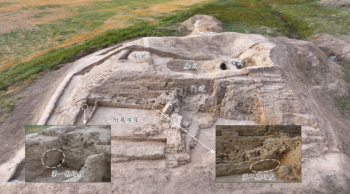
Since 2018, the Shaanxi Academy of Archaeology has worked with the Institute of History, Archaeology and Ethnology of the National Academy of Sciences of the Kyrgyz Republic to investigate the Krasnaya Rechka site in Kyrgyzstan.
Located in the Chuy Valley in the eastern part of the Chu River Basin, the site lies along a key corridor of the ancient Silk Road that linked China's Xinjiang Uygur Autonomous Region with West Asia. Scholars widely identify it as Navekat, an ancient city mentioned in Sogdian and Muslim literature and referred to in Tang Dynasty records as Xincheng, meaning "New City". Founded by Sogdian people in the 6th century, the city was abandoned in the early 13th century.
Chinese specialists have used LiDAR remote sensing to create a digital elevation model and map the site's boundaries with precision. Building on this work, they also established a digital archaeology information platform for the Chuy Valley. The team's research has revealed that the western city area is roughly square when viewed from above and covers about 0.39 square kilometers. Its walls are discontinuous, and buildings are relatively sparse, with most concentrated in the western part of the area.
The team also excavated a large building in the western city area to investigate its structure and building techniques. More than 20 tombs, pits and house foundations have been identified west of the building. The excavations have yielded more than 100 cultural relics, most dating to the Kara-Khanid Khaganate, which ruled parts of Central Asia from the 9th century to the early 13th century.
Valery Kolchenko, the Kyrgyz head of the joint archaeological team, says the site yielded Tang Dynasty coins from China, artifacts bearing Sogdian inscriptions, Buddhist structures, and Nestorian Christian tombs. "The site lay at a crossroads, where diverse cultures and religions converged and integrated," he says.
The team conducted archaeological surveys of ancient city sites across the Chu River Basin, and identified 24 sites. The findings suggest that cities in the Chuy Valley and the nearby Issyk-Kul region flourished between the 8th and 12th centuries.
Source: CSSN