
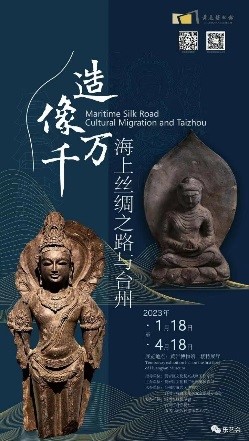
The exhibition Maritime Silk Road Cultural Migration and Taizhou is on display at the Huangyan Museum in Taizhou, Zhejiang province, China from January 18 to April 18, 2023.
Located on the southeast coast of China, Taizhou has been a bustling maritime hub since ancient times. It is one of the key starting points of the ancient Silk Road routes, with distinctive regional qualities characterised by openness, inclusiveness and diversity.
During the Han (202 BCE–220 CE) and the Six Dynasties (220–589 CE) period, regions along the southeast coast of China actively engaged in maritime activities and established relatively smooth maritime routes. They were the rudimentary beginnings of the Maritime Silk Road and Taizhou became one of its key starting points. Abundant trade and frequent travel during the Tang and Song dynasties (618–1279 CE) prompted in-depth, comprehensive and multi-faceted cultural exchanges.
Taizhou is also a cradle for Chinese Buddhism and Daoism. Buddhism in Taizhou experienced several stages of development, including the religion’s dissemination to the area during the Han and the Six Dynasties period, the establishment of Tiantai School of Buddhism during the Sui and Tang dynasties (581–907 CE), and spread to Korea and Japan after the Tang and Song dynasties (618–1279 CE). The styles and craftsmanship of Buddhist sculpture remains in Taizhou from these periods are consistent with the developmental stages depicted above, vividly reflecting the dissemination of Buddhist art and foreign exchanges in Taizhou.
The exhibition connects cultural dots into themes that illustrate a grand historical setting. Using the Silk Road as its main narrative theme, the exhibition is furnished with stories of local people, objects and events; and shows the craftsmanship, styles and cultural undertone of the exhibits consistent with Southeast Asian artworks from various periods.
Source: Huangyan Museum