
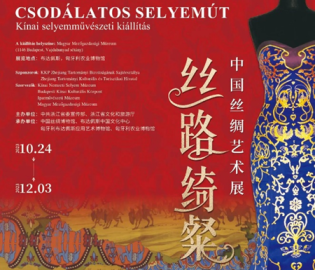
On October 24, the exhibition Charm of the Silk Roads: Auspicious Designs on Chinese Silk Art opened at the Museum and Library of Hungarian Agriculture in Budapest, Hungry. The exhibition is organized by China National Silk Museum (CNSM) in collaboration with the China Culture Center in Budapest, the Museum of Applied Arts of Budapest, and the Museum and Library of Hungarian Agriculture, as the concluding event of the 2023 Silk Road Week and the debut of the “CNSM Global Showcase” project.
Open until December 3, the exhibition consists of three sections: "Silk and the Silk Road", "Ancient Silk Patterns" and "Contemporary Revitalization and Application". The featured 60 sets/80 items of ancient silk reproductions and contemporary costumes and accessories are arranged to be a systematical demonstration of the diverse trends in the development of Chinese silk art.
The “CNSM Global Showcase” project aims to develop a series of standardized exhibitions on silk culture that can be displayed in museums, universities, China Cultural Centers and public spaces around the world, establishing a new model for organizing international exhibition tours with the combination of digital displays and representative star exhibits, like “going on tour with a USB flash drive”. In terms of digital displays, CNSM’s extensive collection of classic displays and high-quality temporary exhibitions on Chinese silk and Silk Road culture will be featured in cooperation with interactive presentations of intangible sericulture and weaving techniques and other related contents. In addition, the content can be expanded and upgraded with the inclusion of the international touring partner’s special features. As for physical displays, the focus will be placed on representative Chinese costumes and accessories, traditional patterns and designs, and artworks of innovative design, supplemented by unique cultural relics and other special objects from international touring exhibition partners. The “Showcase” will be at significant advantages over traditional touring exhibitions thanks to its standardization, flexibility (low demands on exhibition space and software/hardware resources), ease maintenance (remote maintenance and upgrade of digital exhibition content), cost-effectiveness and mobility.
Source: China National Silk Museum