
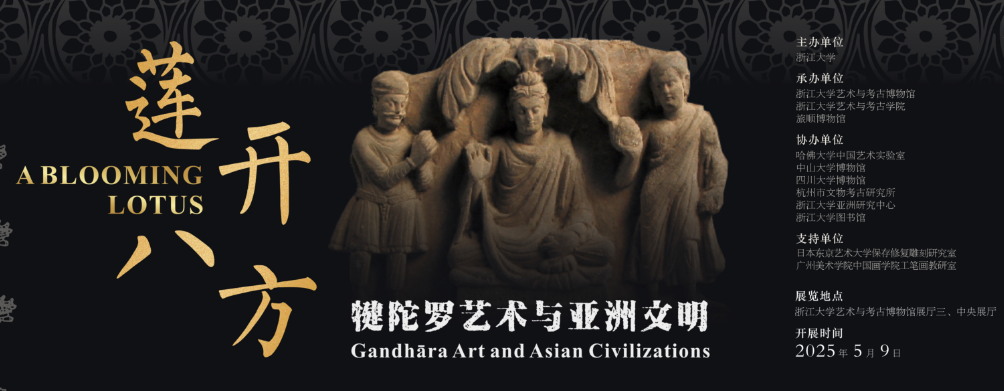
The special exhibition A Blooming Lotus: Gandhāra Art and Asian Civilizations opened on May 9 at the Zhejiang University Museum of Art and Archaeology in Hangzhou, China.
Sponsored by Zhejiang University and organized by its Museum of Art and Archaeology, School of Art and Archaeology, and the Lvshun Museum, the exhibition features over 150 outstanding works of Gandhāran and other Asian art. These pieces are drawn from the collections of the Lvshun Musuem, the Zhejiang University Museum of Art and Archaeology, the Sun Yat-sen University Museum and the Sichuan University Museum. Through a rich array of archaeological resources, the exhibition presents a panoramic view of the splendor and charm of Gandhāran art. It exploresthe art form’s influence and contributions to Asian civilizations from diverse cultural perspectives, highlighting the historical significance of dialogue, harmonious co-existence and joint development among civilizations.
Gandhāra, located in the northwestern region of the South Asian subcontinent where was a critical hub on the ancient Silk Road, was successively shaped by artistic influences from Persian traditions in West Asia, Greco-Roman styles from Europe, and Indian art from South Asia. Gandhāran art emerged from the integration and interaction between these major artistic traditions from as early as the 6th century BCE. After the mid-1st century CE, it reached new heights under the rule of the Kushan Empire. As trade flourished on the Silk Road and Buddhism spread eastward, Gandhāran art made its way to China and further to the Korean Peninsula and the Japanese archipelago, leaving a profound and lasting impact on sculpture, painting and architecture throughout Central and East Asia.
Source: Zhejiang University Museum of Art and Archaeology