
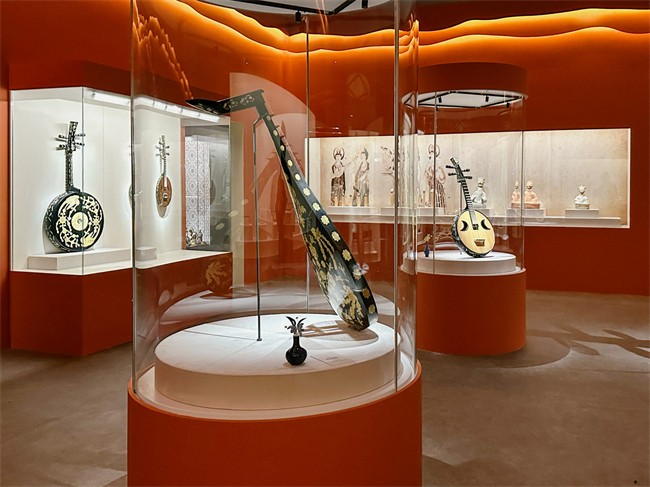
The exhibition Sound of Harmony: A Journey Through Ancient Chinese Music opened on September 28 at the National Museum of Saudi Arabia in Riyadh. Jointly organized by China’s National Cultural Heritage Administration, the National Museum of China, and the Museums Commission of the Kingdom of Saudi Arabia, the event celebrates the 35th anniversary of the China–Saudi diplomatic relations and the 2025 China–Saudi Arabia Year of Culture.
Music is a language that transcends time and space—a bridge connecting hearts. In this exhibition, the ancient echoes of China meet the resonant melodies of the Arabian Peninsula to compose a symphony of cultural exchange between the two civilizations. Showcasing more than one hundred pieces (sets) of ancient Chinese musical artifacts—from prehistoric bone flutes to exquisite instruments from the Ming and Qing dynasties (1368–1911)—the exhibition presents a comprehensive view of China’s millennia-old musical heritage and its continuous process of integration and innovation. These instruments not only embody the essence of China’s ritual and musical traditions, but also stand as shared treasures of human civilization.
The success of this exhibition stems from the close collaboration and coordinated efforts between the National Museum of China and the Museums Commission. Their joint efforts have ensured both professional depth and emotional resonance. Through these precious artifacts, Saudi visitors are invited to experience the Chinese philosophical and aesthetic pursuit of “harmony between heaven and earth”. The exhibition also serves as a catalyst for further exchanges and cooperation between museums and cultural institutions in China and Saudi Arabia, deepening mutual understanding and friendship between the two peoples. In doing so, it keeps the dialogue between civilizations alive and contributes to the building of a community with a shared future for mankind.
The exhibition is jointed supported by the Chinese National Museum of Ethnology, the Henan Museum, the Hubei Provincial Museum, and the Xinjiang Museum. It lasts until December 1.
Source: National Museum of China