
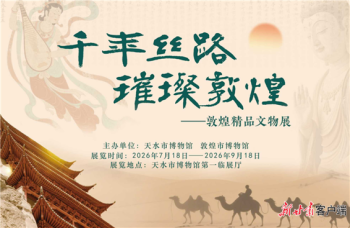
The exhibition Millennial Silk Road, Splendid Dunhuang: Selected Dunhuang Relics opened on July 18 at Tianshui Museum in China’s Gansu province. Jointly organized by the Tianshui Museum and the Dunhuang Museum, the exhibition brings together 88 rare pieces/sets of artifacts unearthed in Dunhuang.
The exhibition is organized into five thematic sections, including “A City at the Crossroads of Cultures” and “Shazhou: A Pivotal Hub on the Silk Road.” Together, they trace Dunhuang's historical development from its establishment as a commandery during the Han dynasty (202 BCE–220 CE), through the Wei, Jin, and Sixteen Kingdoms periods (220–439 CE), to its continued prosperity under the Tang and Song dynasties (618–1276 CE). Among the highlights are Han-dynasty bamboo and wooden slips, ancient Silk Road textiles, Wei and Jin-era portrait bricks, funerary pottery jars, and manuscripts from Dunhuang’s Library Cave. These artifacts offer a vivid glimpse into the pluralistic, open, and inclusive character of Dunhuang as a Silk Road civilization.
As a pivotal hub along the Silk Road, Dunhuang has accumulated an extraordinary historical legacy and a wealth of cultural heritage. Through its presentation of cultural artifacts, the exhibition brings Dunhuang’s cultural heritage beyond the Hexi Corridor to southeastern Gansu. In addition to showcasing the treasures of Dunhuang’s millennia-old history and culture, it serves as a compelling example of Gansu province’s efforts to make greater use of and share its museum resources while advancing the transmission and development of its cultural heritage.
The exhibition is open until September 18.
Source: Phoenix New Media (Gansu)