
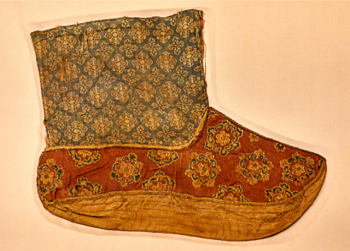
On July 27, the exhibition showcasing evolution of Chinese silks and their embedded meanings opened in Shanghai, bringing together over 100 representative silk patterns spanning five millennia. It is hosted by the Shanghai Social Sciences Development and Research Center and Donghua University Press.
Silk has been one of Chinese civilization’s iconic cultural symbols over thousands of years. The unfading patterns are often seen as its “soul”, mirroring the culture and social conditions of that time as well as embodying ancestors’ observations of nature and daily life.
Wen Run, curator of the exhibition and professor at the College of Textiles, Donghua University, summarizes the silk patterns of the Tang Dynasty at their peak prosperity as “rich, lush, exotic, and vibrant”. They showcased the dynasty’s inclusiveness and openness as a major power, and even exerted a far-reaching influence on Japan and many parts of Southeast Asia, becoming a world-renowned symbol of Eastern aesthetics,” Wen said.
As the agricultural civilization of the Central Plains underwent more profound interactions with nomadic civilization in northern China and the Islamic traditions from the Western regions, silk patterns of the Song (960-1276) and Yuan (1271-1368) dynasties further transcended ethnic boundaries and became more diversified in their themes and styles. Traditional Chinese silk patterns and textile techniques reached a new peak in the Ming (1368-1644) and Qing (1644-1911) dynasties, during which the locally accumulated artistic essence of traditional patterns was delicately blended with extensive cultural exchanges with the outside world. Focusing on “auspicious” themes, the silk patterns also saw a deeper fusion of courtly aesthetics and folk tastes.
After the founding of the New China, the silk industry played a critical role in contributing to the nation’s economic development and diplomatic needs. As the nation launched reform and opening-up in 1978, the silk industry became more connected with the international art and design community. Silk patterns evolved from realism to abstract styles, and traditional Chinese techniques were cleverly refined to align with global fashion trends.
Entering the 21st century, traditional silk patterns, as a cultural heritage, are continuously evolving and increasingly integrated with modern digital technologies and design creativity, shining brightly again on the global stage. “Silk is a gift from China to the world. It is biodegradable, renewable, and sustainable. Silk patterns are symbolic carriers of our history, culture and the whole profound Chinese civilization. They are inclusive, continuously evolving with great vitality, said Wen. “We hope more people will learn more about them, and discover the timeless beauty and charm of our traditional culture.”
Source: China Daily